Starting in 2026, a major change to the U.S. tax code means most people will save money on their taxes simply by giving to charity.
For the first time in years, people who take the standard deduction can claim a charitable tax deduction — up to $1,000 for individuals or $2,000 for married couples.
Below, we break down exactly how much you could save, using real numbers, clear examples, and a simple table you can reference at a glance.
The New 2026 Charitable Giving Tax Incentives
Beginning January 1, 2026:
- Individuals who take the standard deduction can deduct up to $1,000 in charitable donations
- Married couples filing jointly can deduct up to $2,000
- This deduction is above the line, meaning it reduces taxable income before the standard deduction
- The amount you save depends on your tax bracket
About 90% of U.S. households take the standard deduction — which means this change applies to most people.
How the Tax Savings Work
Your tax savings are calculated using a simple formula:
Donation amount × your marginal tax rate = tax savings
That’s it. The higher your tax bracket, the more you save.
What This Means in Practice
For the first time, the tax code creates a clear “smart giving” threshold:
- $1,000 for individuals
- $2,000 for married couples
You can absolutely give more — but these first dollars now come with a built-in tax benefit for nearly everyone.
This is a meaningful shift, standard-deduction filers received no tax benefit at all for charitable giving before now.
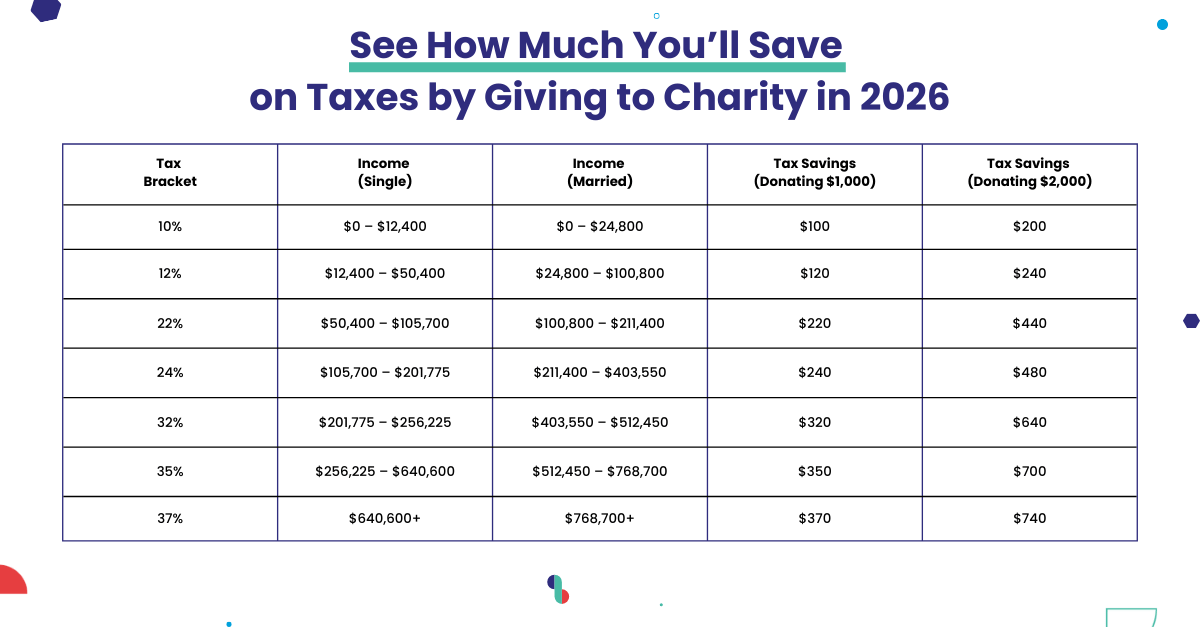
See How Much You’ll Save (By Tax Bracket)
Below is a table showing estimated federal tax savings for common tax brackets when donating:
- $1,000 (single filers)
- $2,000 (married couples filing jointly)
This table gives you a fast way to estimate savings without needing to run a full tax calculation.
Quick Tax Savings Calculator (No Tools Needed)
You don’t need a special calculator to estimate your tax savings from charitable giving in 2026. You can do it in under 30 seconds using your phone.
Here’s how:
Step 1: Determine your filing status
- Single → max deductible amount: $1,000
- Married filing jointly → max deductible amount: $2,000
Step 2: Identify your marginal tax rate
Common federal tax brackets include:
- 10%, 12%, 22%, 24%, 32%, 35%, or 37%
(If you’re not sure, check last year’s tax return or your pay stub.)
Step 3: Use this simple formula
Deductible donation × your tax rate = estimated tax savings
Example calculations
- $1,000 × 22% = $220 saved
- $2,000 × 24% = $480 saved
- $2,000 × 35% = $700 saved
That’s it.
If you donate less than the maximum, just plug in the amount you actually gave. If you donate more, only the first $1,000 or $2,000 qualifies for this specific deduction.
Real Examples Explained in Simple Terms
Example 1: Single filer in the 22% tax bracket
- Donation in 2026: $1,000
- Estimated tax savings: $220
Example 2: Married couple in the 24% tax bracket
- Donation in 2026: $2,000
- Estimated tax savings: $480
Example 3: Higher-income household in the 35% tax bracket
- Donation in 2026: $2,000
- Estimated tax savings: $700
The benefit increases with income — but the deduction cap stays fixed.
How Employers Can Help Employees Maximize These Tax Savings
Employers play an important role in making these new deductions easy for employees to actually use.
1. Align matching gift programs with the new thresholds
Because employees now have a clear tax incentive to give:
- $1,000 (individuals)
- $2,000 (married couples)
Many companies are updating their matching gift programs so employees are encouraged — and rewarded — for giving at least that amount.
Using Percent Pledge’s Giving Platform, employers can easily configure matching rules that:
- Set clear annual match caps (e.g., $1,000 per employee)
- Automatically match eligible donations
- Eliminate forms and manual approvals
If you want a deeper dive on this strategy, we’ve outlined it step by step in our guide on how to update matching gift programs for 2026.
2. Make it easy for employees to give the “right” amount
One challenge with tax incentives is execution: people want to give, but they’re not sure how much or where.
Percent Pledge’s Giving Platform helps by allowing employees to:
- Donate to 2M+ verified charities through a searchable nonprofit database
- Support the causes they care about through vetted Cause Portfolios made up of top-rated nonprofits
- Set up recurring donations (for example, ~$85/month to reach $1,020 per year)
This makes it easy for employees to confidently give enough to fully benefit from the new deduction — without having to think about it at year-end.
What Counts (and What Doesn’t)
To qualify for the 2026 deduction:
Eligible donations
- Cash donations (credit card, ACH, payroll giving)
- Gifts to IRS-qualified nonprofits
- Donations made in calendar year 2026 or later
Not eligible
- Donations to donor-advised funds
- Non-cash gifts (clothing, furniture, stock)
- Company matching funds (only your personal donation counts)
When employees donate through the Percent Pledge Giving Platform, nonprofits are automatically verified and IRS-compliant receipts are generated instantly — making tax filing simpler.
Receipts, Records, and Peace of Mind
Employees do not need to submit receipts to claim the new deduction — but they do need to have documentation if they are ever audited.
Percent Pledge automatically handles this by:
- Generating instant, IRS-compliant donation receipts for every gift
- Storing receipts securely in each employee’s dashboard
- Providing an annual IRS-compliant tax summary that includes all giving throughout the year
Users can download receipts or their annual summary at any time, without having to track paperwork themselves.
How to Make This Easy on Yourself
Many donors choose to:
- Set up recurring monthly giving (about $85/month = $1,020/year)
- Give through their employer’s workplace giving program
- Use platforms that track donations and store receipts automatically
These approaches make it easier to hit the new deduction threshold without having to think about it at year-end.
Why This Matters for Companies
Employers are paying close attention to this change because:
- Employees now have a strong financial reason to give
- Matching gift programs become more effective
- Participation rates tend to increase when giving is both meaningful and financially smart
With a modern giving platform, companies can support employees while also strengthening engagement, culture, and impact reporting.
Final Takeaway
Starting in 2026, charitable giving becomes financially smart for most people — not just generous.
The math is simple.
The incentives are clear.
And with the right tools, the execution can be effortless.
If you want to help employees take full advantage of these new tax savings — while modernizing your giving and matching programs — we’re happy to help. Get a demo today.

.png)