The giving season isn't just about year-end campaigns anymore. For forward-thinking companies, it's an opportunity to activate employees year-round, build lasting culture, and create measurable social impact that aligns with business goals.
But here's the challenge: most corporate giving programs struggle with low participation rates, administrative burden, and difficulty proving ROI. If you're a CSR leader, HR director, or executive sponsor of your company's giving program, you've likely wrestled with at least one of these pain points.
The good news? With the right strategy and infrastructure, employee giving programs can become one of your most powerful tools for engagement, retention, and brand reputation. Here are ten proven strategies to transform your program from checkbox initiative to strategic advantage.
1. Start with Clear, Business-Aligned Goals
Before you launch another campaign, ask yourself: what does success actually look like?
Vague goals like "increase engagement" won't move the needle. Instead, set specific, measurable objectives that tie to broader business outcomes:
- Increase participation rate by 15% (from 20% to 35% of eligible employees)
- Achieve 50% participation from underrepresented employee groups to strengthen inclusion efforts
- Drive $500K in total giving (employee donations + company match) to support strategic cause areas
- Reduce employee turnover by 10% among program participants
Why this matters: Companies with volunteer programs see 50% lower turnover and 89% of Gen Z weighs social impact when choosing employers. Your giving program isn't just philanthropy—it's talent strategy.
Pro tip: Use last year's data as your baseline. Industry benchmarks suggest workplace giving programs typically see 20-30% participation during peak giving seasons, but top-performing programs exceed 50% year-round.
2. Eliminate Friction with Automation and Modern Technology that links directly from your SSO or HRIS.
If your employees have to fill out forms, wait for approvals, or track their own receipts, you've already lost them.
The best giving programs make participation effortless:
- Modern donation experience – Employees should be able to give in under 60 seconds from their phone
- Automated matching – No manual submission or approval process. Donations are matched instantly and transparently
- One-click recurring donations – Make it easy to set up monthly giving to causes employees care about
This isn't just about convenience—it's about access. Frontline workers, remote teams, and shift-based employees can't always sit at a desk to participate. Easy access ensures equity across your entire workforce.
Real-world impact: Companies that prioritize technology see participation rates 40% - 60% higher than companies relying on forms.
Learn more about our user-friendly Workplace Giving Platform.
3. Lead from the Top (and Make It Personal)
Employee giving programs fail when they feel like HR initiatives. They succeed when leadership treats them as cultural priorities.
The most effective campaigns launch with authentic endorsement:
- CEO or executive video explaining why the program matters to the company's mission
- Personal giving stories from leadership about causes they support and why
- Executive participation challenges where leaders match employee donations or volunteer hours
- Board-level visibility on participation metrics and impact outcomes
When employees see executives donating, volunteering, and talking openly about social impact, they're 3x more likely to participate themselves.
Bonus strategy: Pair leadership endorsement with employee ambassadors—team members who champion the program from within departments, offices, or ERGs. Peer influence often drives more action than top-down mandates.
4. Leverage Matching and Cause Credits to Drive Participation
Donation matching isn't just generous—it's strategically powerful.
Here's what the data shows:
- Employees give 2-3x more when a company match is available
- Match programs increase first-time donor participation by 60%
- Double-match days create urgency and spike engagement
But matching alone isn't enough. Consider adding cause credits: pre-funding employee accounts with $5-$100 they can direct to any vetted charity. This removes the financial barrier entirely and gets employees engaged even if they're not ready to give their own money yet.
Pro tip: Highlight match availability in real time. When employees see "Your $50 donation becomes $100 today," urgency and generosity both increase.
5. Activate ERGs and Employee-Led Campaigns
Your Employee Resource Groups aren't just internal communities—they're your most powerful distribution network for social impact.
ERGs naturally align with cause areas and can lead campaigns that feel authentic rather than corporate:
- Pride ERG leading LGBTQ+ nonprofit fundraising during Pride Month
- Veterans ERG organizing volunteer events with veteran service organizations
- Women's ERG supporting domestic violence prevention or girls' education initiatives
- Black Employee Network driving campaigns during Black History Month
When ERGs own giving campaigns, participation within those communities can exceed 70% compared to 20-30% company-wide averages.
Scalable strategy: Give ERGs dedicated budgets, matching dollars, or volunteer event credits they control. This decentralizes engagement and ensures your program reflects the diversity of causes your employees care about.
6. Personalize the Experience (Because Generic Doesn't Work)
Would you send the same email to every customer? Then why send the same giving campaign to every employee?
Personalization dramatically increases engagement:
- Cause recommendations based on past donation history or volunteer interests
- Geographic targeting highlighting local nonprofits near each office or remote employee
- Department-specific campaigns (e.g., engineering teams supporting STEM education nonprofits)
- Milestone recognition celebrating employees' giving anniversaries or volunteer hour milestones
Modern giving platforms can surface curated nonprofit lists based on employee preferences, location, and engagement patterns. This makes discovery effortless and relevant.
Data-driven tip: If 40% of your employees have donated to environmental causes, launch a themed Earth Month campaign. If veterans' causes over-index, create a Memorial Day giving challenge. Let employee behavior guide your campaign calendar.
7. Create Momentum with Themed Campaigns and Friendly Competition
One long campaign loses energy. A series of bite-sized, themed campaigns sustains engagement.
Winning campaign structures:
- Heritage Month Series – LatinX Heritage Month, Pride Month, AAPI Heritage Month, Black History Month (each with curated nonprofit partners)
- Cause-Themed Weeks – Environmental week, education week, health equity week
- Crisis Response Campaigns – Disaster relief, humanitarian emergencies (with rapid-deploy matching)
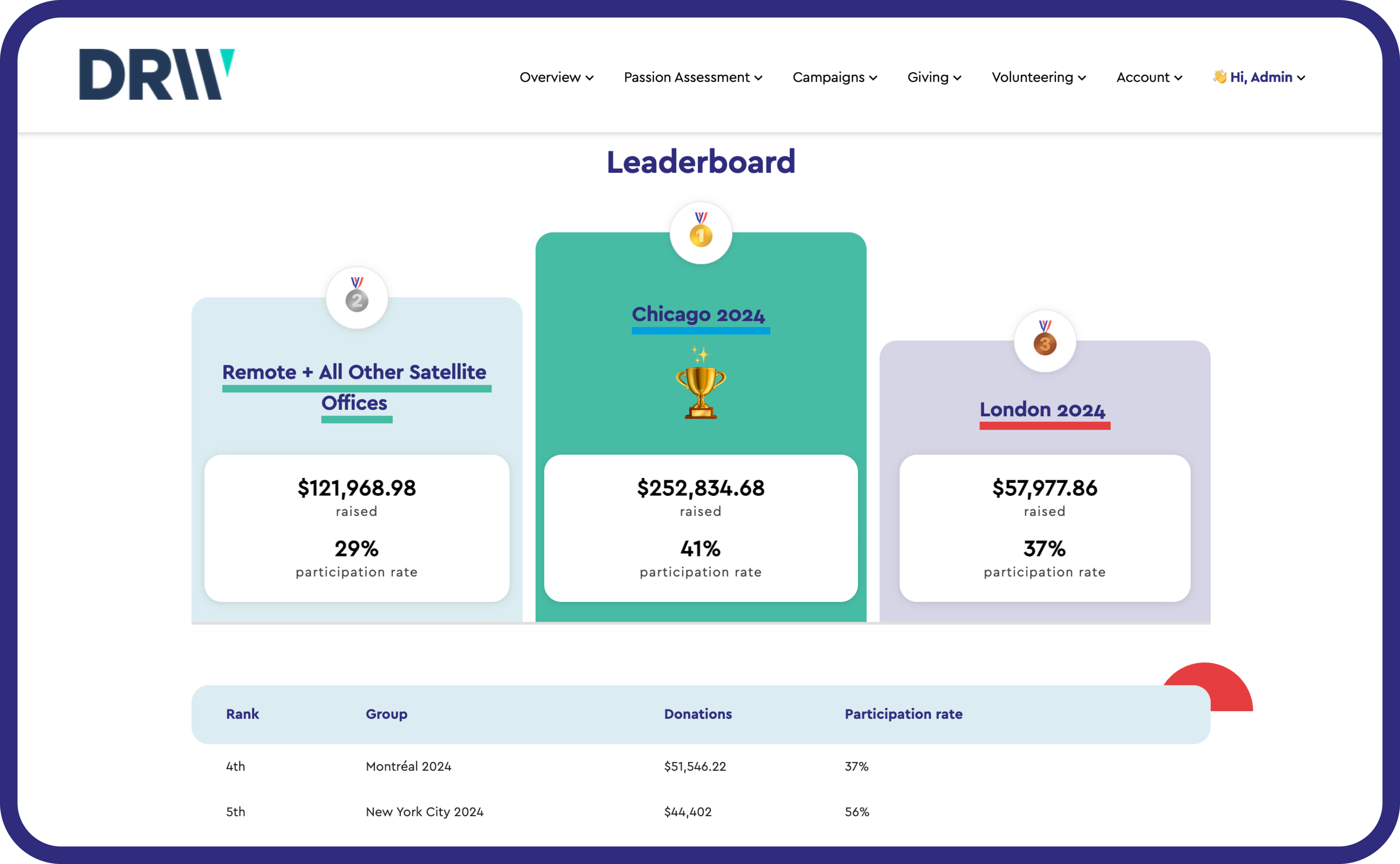
- Friendly Competitions – Office vs. office, department vs. department, individual leaderboards
The psychology: Variety keeps messaging fresh. Competition (when inclusive and celebratory) taps into team pride. Short, focused campaigns feel more manageable than "donate anytime."
Important caveat: Keep competition lighthearted. Celebrate participation, not just dollars. High-income employees shouldn't dominate leaderboards—consider tracking participation rate by department rather than total dollars raised.
8. Make Impact Visible in Real Time
Employees need to see that their contributions matter. Abstract philanthropy doesn't inspire—tangible impact does.
Ways to showcase results:
- Live dashboards on your intranet showing total dollars raised, volunteer hours logged, and employees participating
- Impact milestones – "We just reached $10K! That's 500 kids with school supplies."
- Nonprofit spotlights – Share videos or stories from organizations your employees supported
- Geographic impact maps – Visualize where your company's giving is making a difference globally
Real-world example: One company created a real-time office based tracker during their campaign, celebrating every donation. The visibility alone increased participation by 35% mid-campaign.
Critical mindset shift: Celebrate participation, not just dollars. An employee who donates $25 matters just as much as one who donates $1,000. Inclusive recognition builds culture; elitist recognition breaks it.
See how DRW made impact visible across 11 global offices during its Annual Giving Challenge.
9. Integrate Volunteering (Because Giving Isn't Just Financial)
Donation matching gets the headlines, but volunteering drives deeper engagement and retention.
The data is compelling:
- Corporate volunteering participation increased 50% year-over-year in recent years
- Employees who volunteer through their employer are 70% more likely to stay with the company
- Volunteering creates stronger emotional connection to company mission than donations alone
How to integrate volunteering into your giving program:
- Offer paid volunteer time off (VTO) so participation doesn't compete with work
- Host team volunteer events that double as relationship-building (especially for remote teams)
- Track volunteer hours toward company goals (e.g., "10,000 volunteer hours by year-end")
- Pair donation drives with volunteer opportunities at the same nonprofits
Pro tip: Virtual volunteer events eliminate geographic barriers. Employees can tutor students, mentor entrepreneurs, or provide pro bono consulting from anywhere.
10. Close the Loop with Impact Reporting (and Use It Strategically)
The campaign ends. The impact story begins.
Most companies fail to communicate what happened after employees gave. This is a massive missed opportunity.
Essential closing elements:
- Final results announcement within 2 weeks of campaign close
- Visual impact report showing total raised, participation rate, volunteer hours, nonprofits supported
- Employee stories – Highlight why individuals gave and what it meant to them
- Nonprofit outcomes – What did the partner organizations accomplish with the funds?
- Year-over-year growth – Show progress and momentum
Strategic uses for impact reports:
- Recruiting materials – Attract purpose-driven talent by showcasing your program's reach
- Investor/ESG reporting – Quantify social impact for stakeholders and rating agencies
- Client proposals – Differentiate your company by demonstrating authentic community commitment
- Internal culture reinforcement – Remind employees they work for a company that walks the talk
Our clients' social impact leaders said they were expected to show measurable results from their programs. Impact reporting isn't optional anymore—it's how you prove ROI.
Learn more about the ready-made impact reports Percent Pledge delivers for clients.
The Bottom Line: Giving Programs Are Talent and Business Strategy
Here's what most companies miss: Employee giving programs aren't just about corporate social responsibility. They're about building the kind of culture that attracts top talent, reduces turnover, and strengthens your brand.